A New Nation
Why a New Nation Must Rethink Identification
I was enthusiastic when asked to contribute thoughts on digital identity by the Authorship Team for Secession by Western Australia. Keen to start, I went to log into my Substack account ..
Then came the prompt.
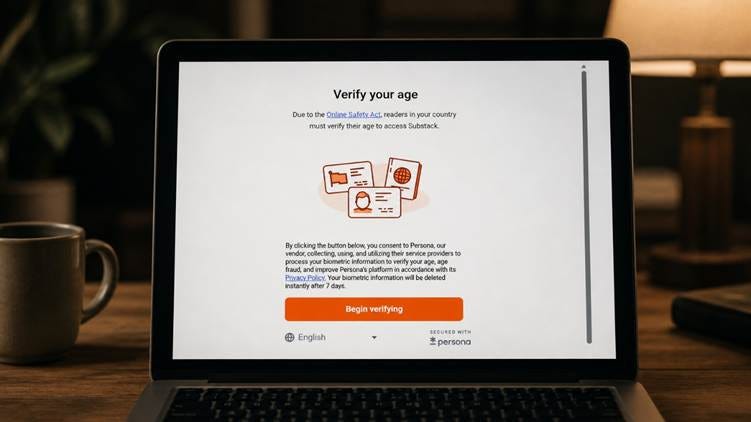
As an Australian, new laws required me to complete biometric age verification to proceed.
I paused.
That small moment captured something larger:
the point where identification morphs from background friction into
a condition of participation.
Australia’s federal political system had, in effect, elevated itself to gatekeeper—demanding I reveal who I am to a third-party for permission to critique it on a writer’s platform.
It felt, in a small way, reminiscent of an earlier practice—when typewriters in parts of the Soviet bloc were registered so anonymous writing could be traced back to its source.

The mechanism has changed. The principle has not.
Put simply:
I needed to digitally identify myself to the very system I was questioning.
The significance is easy to dismiss.
It was just one check from one platform, right? Why worry? I could pass it easily—prove I was over 16.
Requests for identification from both government and business have become routine. Expected. Often unremarkable. We’ve all had to show a driver’s licence to hire a trailer, or buy a beer.
And yet something about the Substack experience felt different.
Not because I couldn’t pass the check. But because I now needed permission to do something that had previously required none.
Where does that stop?
Who sets the conditions—
and what holds them accountable?
These systems don’t simply verify identity. They increasingly define the terms of social participation.
And they tend not to remain isolated. They set precedents.
What begins as a single check becomes a pattern.
Not long ago, being asked to take a selfie while holding a handwritten note to a camera would have felt absurd—more like a police lineup than everyday life.
Now, it’s a recognised process when opening an account. Even if we still grumble about it.
Today, every platform, bank, and service wrestles with verification: different providers, varying standards, and growing compliance demands.
This is where governments often step in—sometimes in an effort to simplify what has become fragmented and unwieldy. Their proposals can, at first glance, sound reasonable.
“Centralise it. Link to a common system. Let one infrastructure handle who people are—and what they can access.”
The shift is gradual. Easy to miss. Until, at some point, a line is crossed.
Which is why the inclusion of a prohibition on national digital identity in the proposed new WA Constitution chapter of Secession by Western Australia is worth pausing on.
It is one of the more unusual—and deliberate—features of the new nation.
Article 1 of Title 7 is soberingly clear in its intent:
“Congress shall not establish or impose any universal national digital identity system or biometric identification registry of the population.”
In plain terms, it draws a hard line.
No single system through which people are universally identified and judged.
No central registry tracking the population across the full span of their lives,
nor the daily activities that make up those lives.
That is a strong position to take, even excessive at a cursory glance.
Nothing quite like this exists in current constitutions.
Why limit it?
One answer is philosophical.
The proposed structure rests on a long-standing idea—one that’s being quietly inverted in the modern West:
that government exists to serve the people, not the other way around.
But before getting there, it helps to recognise something more basic—
Identification is not neutral.
To identify someone—to know something about them—is to gain an advantage over them.
You see this everywhere.
A fighter studies footage of an opponent to find weaknesses.
A company profiles its customers to predict behaviour.
In other contexts, the relationship is even clearer.
Blackmail only works if something is known.
Military reconnaissance exists to gain strategic advantage.
Information changes the balance between two parties.
And when that information is used to make decisions—to grant access, deny it, prioritise, or exclude—that advantage becomes power.
The kind of power exercised in the Soviet bloc.
Access to services, opportunities, and platforms is rarely unconditional. It is mediated by what’s known about the person seeking access—or what they represent. Usually, the terms are opaque.
The individual is identified.
The system evaluating them is not.
Howthat identification happens also matters.
Some identifiers, like usernames and passwords, can be replaced.
Others cannot.
The face Substack asked me to verify—my face—is not something I can change. It is part of me, not a credential I can reset.
And it’s the same face seen by cameras when I’m in a mall, airport, even Bunnings.
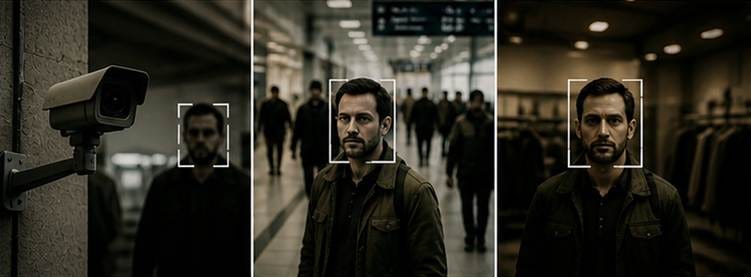
Identification that relies on something as persistent and personal as a face, allows systems to more easily recognise the same individual across contexts, platforms and locations.
Over time, that allows separate systems to assemble the jigsaw pieces of our lives—linking what were once separate fragments into a complete picture.

What happens when that picture attracts attention?
Anyone who has experienced a tax audit understands the feeling of being examined in detail.
Yet the ATO sees only one piece of the puzzle—your financial life.
When the whole picture is assembled, that boundary disappears.
Scaled up, this matters.

Even the possibility that activity in one part of life—such as being observed attending a public event—could be referenced in another is enough to change behaviour.
At that point, individuals no longer act freely, but in response to what might be held against them.
And identity systems tend not to remain narrow.
The same algorithm that gates access based on age today—can, in principle, be applied more broadly over time.
We saw elements of this dynamic during COVID, where decisions in one area—such as health status—began to affect access to work, travel, and other aspects of life.
Access in one area became dependent on conditions in another.
Thus, a centralised, national identity system is not just an administrative tool
—it is infrastructure through which the population
can be known,
categorised, and
acted upon.
And like any infrastructure, once the pipes are laid, it becomes much harder to control—and especially stop—what flows through them.
That’s why identification boundaries matter.
That’s the power imbalance this Constitution boldly targets—not just central registries, but biometric ones.
Which brings us back to the core question.
If government serves citizens,
what permits public servants
to systematically identify and track citizens across their lives?
Servants do not scrutinise their masters.
In most contexts, the direction of observation is clear.
In your home, you install security cameras. You choose what is seen. You monitor what approaches.
It is your space. You have a vested interest in what happens there.
Guests arrive when invited. Tradesmen come for specific purposes. Their presence is temporary and conditional.
Observation, in that setting, feels natural.
You do not expect the relationship to run the other way.
Imagine if every visitor arrived filming you instead—throughout your home.
Most would call that a violation.
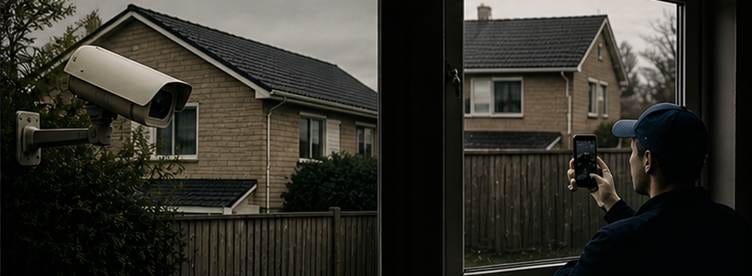
At national scale, this is the inversion.
Citizens are at home in their country.
Government employees are the service providers citizens hire
—and it is they who should be scrutinised.
Under that framing, it becomes difficult to justify any system in which the population is continuously identified, tracked, or profiled by their employees.
Title 7 of the new Western Australian Constitution can be understood in this light.
It is not simply about privacy.
It is about the direction of observation—and the direction of power.
It recognises that if this boundary is not set early, it becomes difficult to set at all.
Yet Title 7 does not stand alone.
It sits within a broader structure that aims scrutiny in a different direction.
Under the new Constitution, public institutions are made increasingly transparent—through audit trails, disclosure systems, and citizen oversight—while individuals are protected from unnecessary surveillance.
This inversion is deliberate.
When a public representative misbehaves privately, citizens should know. It is a condition accepted when seeking office. Private conduct properly informs public trust.
Government serves citizens.
Citizens scrutinize government.
And Western Australia’s small population in a post-secession setting makes observation personal.
That’s why the new Constitutional ban targets this power direction.
It reflects a view that scrutiny should attach most strongly to those exercising power on behalf of citizens, not for citizens to be subject to it. The aim is not blanket prohibition, but precision in where identification applies.
Yet that principle does not enforce itself. It depends on how it is interpreted—and whether it is sustained in practice.
Any prohibition of this kind hence carries implicit obligations.
First, it must be interpreted to capture function, not just form.
Technology will change. Methods of identification will evolve. What matters is not whether a system matches today’s “digital identity” definition, but whether it produces the same effect—broad, routine bureaucratic unmasking of the public across domains of life.
Second, it must be culturally supported.
A constitutional prohibition forbidding a national digital identity system is not only a legal boundary. It reflects a collective judgment.
It signals that a practice is considered significant enough to limit before it becomes normal.
If that judgment isn’t reflected in everyday behaviour, limits become hard to sustain.
Where identity requests feel routine, even clear legal limits lose force. Restoring small friction—where such requests invite explanation rather than assumption—keeps the legal intent alive in practice.
Just as Americans continually exercise freedom of speech and firearm rights to resist gradual erosion, WA citizens must push back against small steps converging toward universal identification, by whatever name.
And there’s subjective cultural evidence to suggest that call can be answered—after all, Western Australia is still yet to adopt digital driver’s licences, perhaps not as laggards, but as careful guardians of what works.
And that really is the point. None of this requires rejecting identification outright.
It requires recognising that like any tool, it has a scope.
Used selectively, it can support function.
Used broadly, it can begin to condition participation.
The Substack prompt that stopped me cold was not just friction.
It was a glimpse of that shift.
The Title 7 prohibition does not attempt to perfect identification.
It does something more restrained.
It sets a boundary.
And in doing so, it offers a choice. One that may prove to be one of the more important design decisions for a new nation.
Not between technology and no technology—
but between countries
that increasingly require you to identify yourself at every turn,
and one that accepts
that not every interaction needs to know who and where you are.